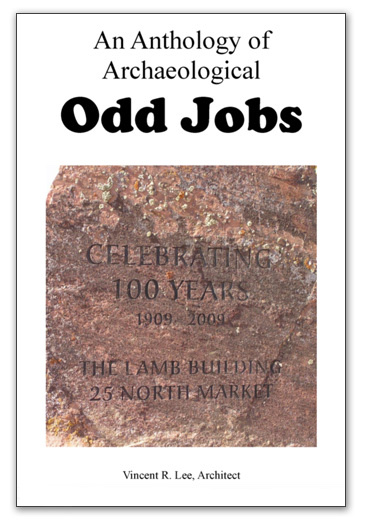
AN ANTHOLOGY OF ARCHAEOLOGICAL ODD JOBS
This is a collection of the author's previously unpublished papers and stories as well as brief summaries of projects done in collaboration with colleagues.
My father, Claude F. Lee, Sr., led a very interesting life. Born in the Appalachian Mountain town of Asheville, North Carolina, he was the son of the county sheriff and was just beginning studies at the local Junior College when the First World War broke out. Like many men his age at the time, he enlisted in the Army and was soon on the battlefields of France. As boys, my brother and I occasionally heard stories of his luck as men on each side fell in the insane frontal attacks that too-often characterized that conflict. Early on though, he was sent to officer school and reassigned to aerial intelligence, photographing the action from the front seats of bi-wing airplanes. War's end found him in Paris, the classic farm boy whose eyes were opened there to the wide world beyond the hills and hollows of his youth.
On his return home, he met, courted and married my mother and the two were off to seek their fortunes in then booming Florida, where his fascination with "movies" he'd seen in Europe drew him into the theater business. His success quickly caught the attention of Paramount Pictures, then headquartered in New York, and he was asked to lead their new "public relations" department. His long career exactly coincided with the heyday of the movies, putting him in constant contact with all the film stars of the era in both Manhattan and Hollywood. At the close of World War Two, he was assigned the task of filming the formation of the United Nations in San Francisco, where he became acquainted with many of the famous world leaders in attendance. As a boy, I was only vaguely aware of all this, but one thing he said I recall as though it was yesterday. He'd tell my mother, "You know, I ought to write a book about all this." He never did. Even as a kid, I thought, That's one mistake I'll never make!
And so, I haven't. I've written briefly about my own eye-opening, early tour with the Marines, and more fully about my several "careers" as an architect, mountain guide, explorer and, most recently, as an amateur archaeologist. "Amateur" sums it up best. I did it all for the fun of it, even the writing. This collection recounts a few archaeological projects that didn't quite fit anywhere else and either didn't seem to rate stand-alone, formal publications or were done in collaboration with friends and colleagues who published my contributions elsewhere. As a writer, I've long hoped to become a real "author," writing fiction. I think next time I will. Two of the selections here may give an idea how good my chances are of succeeding.
The Artifact
The Artifact is brief tongue-in-cheek story I wrote at the very beginning of my forty-year "career" in avocational archaeology, inspired by my own beginner's experience in the midst of a then-ongoing Peruvian dispute between two archaeological news-makers I'd only recently met. The other issues then in the headlines centered on problems being uncovered within the LDS Church down in Salt Lake City. The Book of Mormon suggested a fanciful connection between the two otherwise unlikely stories. I cast myself as "Biff," the neophyte Ivy-League messenger-boy.
Mapping Espíritu Pampa
Mapping Espíritu Pampa ties together my initial fieldwork once I ventured to Peru, sketch mapping the overgrown and long-abandoned ruins of Vilcabamba the Old, the final redoubt of the once-powerful Incas. Despite being totally untrained in archaeology, I was determined to document the site, located at Espíritu Pampa, a jungle-choked valley in the Upper Amazon. Armed with only a LANDSAT image of the terrain, compass, machete and notebook, I recorded several hundred structures and their layout scattered through the rain forest. Not until thirty years later would the site be cleared and plotted by GPS. How close were my maps to the results?
Inka Royal Estates
Inka Royal Estates were another focus of my early work in Vilcabamba. Aside from Espíritu Pampa, the other major Inka site in the province was Vitcos, on the hilltop of Rosaspata. It had been built by Pachacuti, the illustrious ninth king of the Inkas as a personal retreat when visiting the region, far from the capital at Cuzco. Elsewhere, several other sites reputed to have been such royal "country estates" seemed quite unlike one another and Vitcos until they were mapped and studied in greater detail.
Surprisingly, the very same elements characterized the royal precincts of all, their arrangements differing only in accommodation of the terrain. Discovery of this pattern may have established a template for the identification of other such sites.
105 pages
NEW DIGITAL AND PHYSICAL FORMATS COMING SOON
Gallery