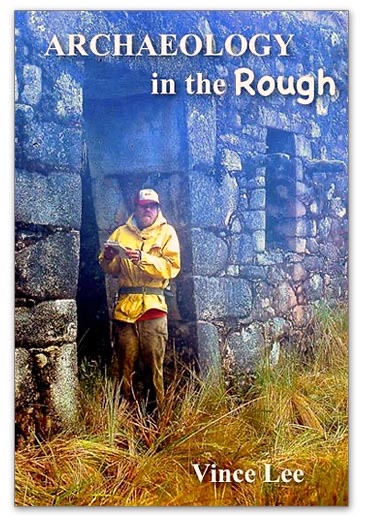
ARCHAEOLOGY IN THE ROUGH: Thirty Years Exploring in the Andes
Ten of Vince Lee's annual papers presented at Berkeley are included in this insightful compilation recounting the journeys and ultimate rewards of archaeological explorations in the Andes
Growing up on the long-abandoned Hudson River estate of John Charles Frémont, the controversial “Pathfinder of the West,” set me on the road to adventure and exploration as early as I can remember. A career as a self-employed architect guaranteed that time off was my own to choose. A part- time second career seasonally guiding mountain climbers all over the world exposed me to wonders I’d scarcely dreamed of as a boy. But I eventually lost both the ability and the desire to continue hard, alpine accents. About that time, I read Gene Savoy’s classic book, Antisuyo, recounting his explorations in the jungles of Peru. I was hooked, and remain so to this day. Finding “lost cities” in the high Andes would be my next career.
First, I followed in Savoy’s footsteps and picked up where he had years ago left off in the remote and vaguely perilous province of Vilcabamba. It was where the Incas made their last stand, and but for brief visits by Savoy and Hiram Bingham, the famous discoverer of Machu Picchu in 1911, it remained largely unexplored and its many Inca ruins were unstudied. Some, described in Spanish documents of the period, remained unfound! How could I resist a challenge like that? My wife Nancy and I devoted the next four years to piecing together the rich and tragic story of the Incas’ final decades free from European rule. Then, as now, our methods were strictly old school: a compass in one hand and a machete in the other. The fascinating story is told in my book, Forgotten Vilcabamba, Final Stronghold of the Incas and has received five stars from every reader that has posted a review on Amazon.
Since then, we have pursued similar projects all up and down the Andes. From Ecuador to Bolivia the opportunities for exploration were everywhere and our work bringing them to light gradually caught the attention of the academic community. We were doing work that professional archaeologists could scarcely find funding for and our documentation of what we found was thus a valuable contribution to their work. The result was membership in John Howland Rowe’s Institute of Andean Studies, at Berkeley, and annual papers presented there describing our projects. Of these, ten are included here and should give an idea of both the physical and the intellectual rewards of years in the Andean bush, uncovering the mysteries of the past.
Sixpac Manco: Travels Among the Incas
Sixpac Manco: Travels Among the Incas was my first effort at recounting our experiences for others to read. It resulted from a flap with no other than Gene Savoy, the man whose book had been my inspiration. That story is told in Forgotten Vilcabamba, Final Stronghold of the Incas. This tale deals with the ascent of Pico Iccma Ccolla, a granite crag overlooking the ruins that both Savoy and Bingham had reported deep in the Amazonian rain forest. It was the first of our more than thirty expeditions in the Andes. Until now long out of print, Sixpac Manco is regarded as a classic by my fellow explorers.
Vilcabamba, Last Stronghold of the Incas
Vilcabamba, Last Stronghold of the Incas is a brief summary of all that I learned about the bloody history of the Incas’ final redoubt after returning from Sixpac Manco I, the ascent of Iccma Ccolla. Getting to and from the climb had introduced me to the fascinating world of the Incas and left me thirsty for more knowledge of their magnificent empire and it’s tragic fall in the wake of the Conquest. Unlike the Aztecs, whose fate was sealed soon after the arrival of Cortez in Mexico, the Incas held out for forty years in the jungles of Vilcabamba before being subdued, finally, by the Spaniards. This is the story of their heroic, but ultimately futile resistance to foreign rule.
Puncuyoc Revisited
Puncuyoc Revisited summarizes the results of a series of expeditions to the Inkawasi (house of the Inca), a near-perfectly preserved relic from the world of the Incas. Isolated in a 13,000-foot pass in the remote Cordilllera Vilcabamba, it was re-re-re-discovered during Sixpac Manco II, our second trip to Vilcabamba. Its many features and pristine condition make it a rare laboratory for the study of Inca design and construction, but for what purpose was it built? Twenty years after our first encounter, with help from friend and archaeoastronomer, Bernard Bell, we finally figured out the answer.
384 pages
NEW DIGITAL AND PHYSICAL FORMATS COMING SOON
Gallery